

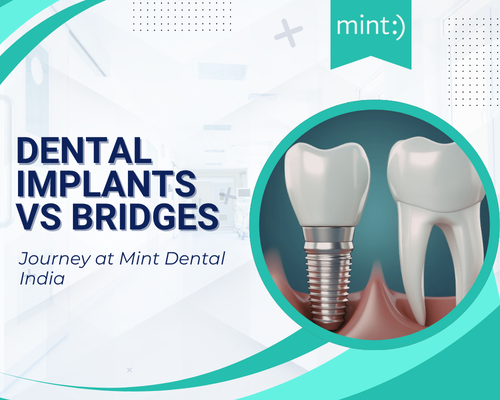
Missing teeth can affect much more than your appearance. They can make it difficult to chew food, speak clearly, and maintain good oral health. Fortunately, modern dentistry offers effective solutions to replace missing teeth. The two most common options are dental implants and dental bridges.
Many patients visiting Mint Dental Clinic often ask, "Which option is better for me?" The answer depends on several factors, including oral health, budget, and long-term goals. In this case study, we explain the differences between dental implants and bridges and help you understand which solution may provide the best long-term benefits.
Understanding the Patient's Concern
A 42-year-old patient visited Mint Dental Clinic after losing a molar tooth due to severe decay. The patient wanted a permanent solution that would restore function and appearance while preventing future dental problems.
During the consultation, Dr. Khushboo Ronak Khokhani and Dr. Ronak Mukesh Khokhani evaluated the patient's oral condition and discussed two treatment options: Dental Bridge and Dental Implant. The patient wanted to understand which treatment would be the better investment for long-term oral health.
What Is a Dental Bridge?
A dental bridge is a prosthetic tooth that fills the gap created by a missing tooth. It is supported by the adjacent natural teeth on either side of the gap. To place a bridge, the neighboring teeth are reshaped and fitted with crowns. The artificial tooth is then attached between these crowns.
Benefits of Dental Bridges
- Faster treatment process
- Lower initial cost
- No surgical procedure required
- Restores chewing and appearance effectively
Limitations of Dental Bridges
- Requires removal of healthy tooth structure from adjacent teeth
- May need replacement after 10�15 years
- Does not prevent bone loss in the jaw
- Higher risk of decay around supporting teeth
What Is a Dental Implant?
A dental implant is a titanium post placed into the jawbone to replace the missing tooth root. After healing, a dental crown is attached to the implant, creating a strong and natural-looking tooth replacement.
Benefits of Dental Implants
- Looks and functions like a natural tooth
- Preserves jawbone health
- Does not affect neighboring teeth
- Highly durable and long-lasting
- Improves chewing efficiency and comfort
Limitations of Dental Implants
- Requires minor surgical placement
- Higher initial investment
- Healing period is necessary before final restoration
Quick Comparison: Implants vs Bridges
| Feature | Dental Implant | Dental Bridge |
|---|---|---|
| Affects adjacent teeth | ? No | ? Yes |
| Preserves jawbone | ? Yes | ? No |
| Longevity | ? Lifetime (with care) | ?? 10�15 years |
| Surgery required | ?? Minor surgery | ? No |
| Initial cost | ?? Higher | ? Lower |
| Natural look & feel | ? Excellent | ? Good |
| Long-term value | ? Superior | ?? Moderate |
The Clinical Evaluation
During the examination at Mint Dental Clinic, the patient's neighboring teeth were completely healthy and free from decay. The jawbone density was also adequate for implant placement.
Because the surrounding teeth were healthy, Dr. Khushboo Ronak Khokhani and Dr. Ronak Mukesh Khokhani recommended a dental implant as the preferred long-term solution. The doctors explained that placing a bridge would require grinding down two healthy teeth. In contrast, an implant would replace the missing tooth independently without affecting adjacent teeth.
Treatment Performed
The patient chose a dental implant after understanding the long-term advantages.
Step 1: Implant Placement
A titanium implant was placed into the jawbone under local anaesthesia. The procedure was comfortable, and the patient experienced minimal discomfort afterward.
Step 2: Healing Phase
Over the next few months, the implant integrated with the jawbone through a natural process called osseointegration.
Step 3: Crown Placement
After successful healing, a custom-designed dental crown was attached to the implant, restoring both function and appearance.
The Outcome
Six months after treatment, the patient reported excellent comfort and confidence. Results achieved:
- Natural-looking smile restoration
- Improved chewing ability
- No impact on neighboring healthy teeth
- Strong and stable tooth replacement
- Preserved jawbone structure
The patient was highly satisfied with the treatment and appreciated the long-term value offered by the dental implant.
Which Option Is Better for Long-Term Success?
Both dental bridges and implants are effective solutions, but dental implants are generally considered the superior long-term option when conditions allow.
Dental Implants Are Ideal If:
- You have healthy gums and sufficient bone support
- You want a long-lasting solution
- You prefer preserving adjacent healthy teeth
- You want the most natural appearance and function
Dental Bridges May Be Suitable If:
- Implant surgery is not recommended
- Bone support is insufficient and cannot be restored
- You need a quicker treatment solution
- Budget constraints are a major concern
Conclusion
When comparing dental implants vs bridges, dental implants often provide the best long-term solution due to their durability, bone-preserving benefits, and natural function. However, bridges remain a valuable treatment option in certain situations.
The best way to determine the right choice is through a professional dental consultation. Early treatment can prevent complications and restore your smile with confidence.
Book Your Appointment Today
Don't let a missing tooth affect your confidence and oral health. Consult the experienced team at Mint Dental Clinic today � Dr. Khushboo Ronak Khokhani and Dr. Ronak Mukesh Khokhani.
Book your appointment today and restore your smile with expert dental care.
Frequently Asked Questions
1. Are dental implants better than bridges?
Dental implants are generally considered a better long-term solution because they preserve jawbone health and do not affect neighboring teeth.
2. How long do dental implants last?
With proper care and regular dental visits, dental implants can last for many years and often a lifetime.
3. Is implant surgery painful?
The procedure is performed under local anaesthesia, making it comfortable for most patients. Mild soreness after treatment is normal and temporary.
4. How long does a dental bridge last?
Most dental bridges last between 10 and 15 years with good oral hygiene and regular dental checkups.
5. Can anyone get a dental implant?
Most healthy adults are suitable candidates. A dental examination and imaging scan help determine eligibility.
6. Which treatment is more cost-effective in the long run?
Although implants have a higher initial cost, their durability and lower maintenance requirements often make them more cost-effective over time.